Module 7: When things go wrong · Lesson 48 of 79 · 5:22 · English
Bathroom overflow, leaks and water in the room

Join the waiting list
Log in
Free. We create your login and email it to you. All 79 lessons included.
What you will learn
In this lesson you learn to respond within minutes, stop the water at the nearest valve, make the room electrically safe, protect the guest's belongings, check the room below, move the guest in the PMS, take the room out of order, dry it within 24-48 hours to prevent mould, and record the cause.
Transcript
0:00
Welcome to the hotel operations course. In this video you will learn what to do when a bathroom overflows, a ceiling starts dripping, or water spreads through a guest room and threatens the rooms around it.
0:15
Water spreads very fast. A delay of a few minutes can damage the carpet, the furniture, the electrical wiring, and even the ceiling of the room below. Here, every minute matters.
0:28
When the guest phones, apologise and tell them straight away: please stay away from the water, do not touch any switch or plug, our team is on its way. Confirm the room number again.
0:40
Send three people together: the technician, housekeeping with towels, buckets and a wet vacuum, and the duty manager to look after the guest. Send them first; everything else can follow.
0:54
As the team sets off, create an engineering job in the PMS with the priority Urgent, and write down where the water is coming from. This keeps both the time and the cause on record.
1:07
The very first job is to stop the water. There is a small valve under the basin and behind the flush. Every room attendant and technician must know where it is and how to close it.
1:19
If the water still does not stop, or if it is coming from the ceiling, engineering closes the main valve for that floor or the whole line. Valves should be tagged, with a map of their locations ready in advance.
1:33
Water and electricity together can kill. If water has reached a socket, extension lead, geyser or light, the technician first switches off that room's breaker, with dry hands and from a dry spot. Only then does anyone step into the water.
1:50
Lift the guest's belongings off the floor at once: bags, shoes, laptop and papers go on the bed or table, with the guest's permission and in front of them. A charger in the water is lifted only after the power is off.
2:05
Then soak up the water with towels and the wet vacuum, and put a wet-floor sign in the corridor. Water also runs under the carpet, so do not be satisfied just because the surface looks dry.
2:18
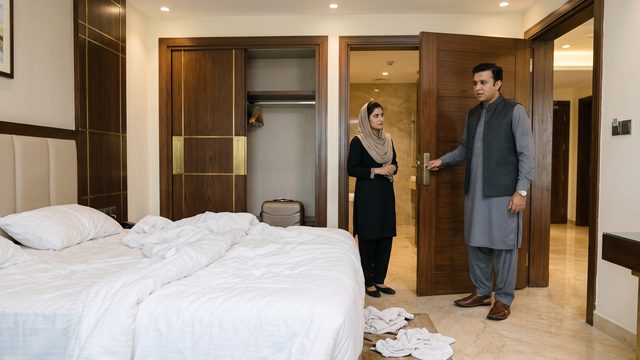
Check the room below immediately. If there is a stain or dripping on the ceiling and a guest is in that room, knock and tell them, and protect their belongings too. Check the neighbouring rooms and the corridor as well.
2:32
If the water is coming from the ceiling, look for the cause above: the bathroom of the room upstairs, a pipe, the AC drain line, or the overflow of the rooftop tank. Do not close the job until the cause is found.
2:47
Do not make the guest stay in a wet room. Apologise sincerely and offer a room of the same type or better. While the new room is being prepared, offer the guest tea in the lobby or the cafe.
3:01
Move the guest to the new room with Change Room in the PMS. The list shows every room with its status, so choose only a clean vacant room. In the reason field, write: water leak.
3:14
The bell boy carefully moves the luggage to the new room, and the guest gets a new key. If anything got wet, offer free laundry or drying, so the guest is not left with damp clothes.
3:27
Once the guest has moved out, set the old room to Out of Order in the PMS, and add a note that there is a water leak. From now on, nobody can check a guest into that room.
3:39
Dry the room completely within 24 to 48 hours, otherwise mould grows in the walls and the carpet. Use fans, a dehumidifier and open windows, and replace a wet mattress or underlay.
3:54
Before the room is sold again, housekeeping and engineering check it together: a damp smell, a wet wall, a stain on the ceiling, and a test of the electrics. If it smells damp, do not sell the room yet.
4:07
If any of the guest's belongings were damaged, photograph them and make a list. The manager decides on compensation within their limit. The front desk makes no promise of its own.
4:21
Sometimes the water is the guest's own fault, such as a tap left running. Even then, help first and do not blame. The manager raises that later, gently, according to hotel policy.
4:34
Our local risks: a tank overflowing because the motor did not switch off, rain coming in through the roof or a window in the monsoon, and a blocked AC drain line. Engineering checks these on its daily round.
4:49
Prevention: when room attendants see a stain on the ceiling, a dripping flush or a loose pipe, they report it at once, and every floor keeps a spill kit ready with towels, a bucket and a wet vacuum.
5:03
Remember: send the team at once, stop the water first, then the power, protect the guest's belongings, check the room below, change the room, set it out of order, and dry it within 48 hours. Thank you.
Module 7
When things go wrong
 46. Hair, insect or glass in the food
5:21
 47. "Your food made me sick": illness and allergic reactions
5:08
 48. Bathroom overflow, leaks and water in the room
5:22
 49. Dirty room, wrong room, bad smell and pests (bed bugs, cockroaches)
5:12
 50. Power cut, AC, hot water, Wi-Fi and a guest stuck in the lift
5:14
 51. Noise, parties, drunk or abusive guests and harassment
5:18
 52. "Something was stolen from my room", lost valuables and guest damage
5:18
 53. Booking not found, overbooked: walking a guest
5:06
 54. A guest falls, gets hurt or becomes ill
5:18
 55. Who can give what: compensation limits, incident reports and follow-up
5:27