Module 9: Breakfast · Lesson 59 of 79 · 5:50 · English
Eggs to order: fried, scrambled, boiled, poached and omelette
Join the waiting list
Log in
Free. We create your login and email it to you. All 79 lessons included.
Transcript
0:00
Welcome to the chef course. In this video you will learn to cook eggs the way each guest likes them: fried, scrambled, boiled, poached and omelette, each one at the right time and the right heat.
0:13
At breakfast, eggs are ordered more than anything else, and every guest likes them a different way. That is why we call it eggs to order. Cook exactly what the guest asks for, and make it the same every time.
0:28
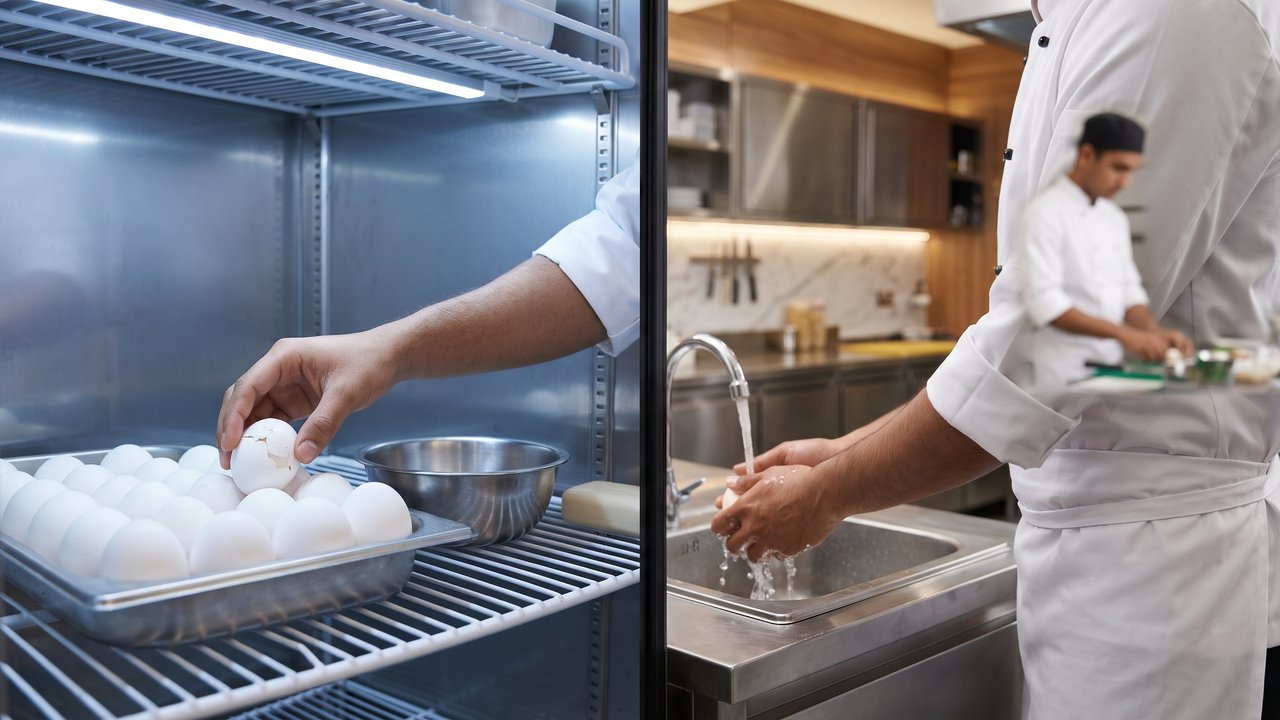
Keep eggs in the fridge below 5 degrees Celsius, and use the older ones first. Never use a cracked or dirty egg. After touching raw eggs, wash your hands before you touch a finished plate.
0:42
Crack the egg on the flat counter, not on the edge of a bowl, so no shell goes inside. Crack it into a small bowl first, then into the pan. If an egg turns out bad, you lose only one.
0:55
The waiter writes clearly on the KOT how the guest wants the egg. For a fried egg, ask: sunny side up, over easy, over medium or over hard. The other choices are scrambled, boiled, poached or omelette.
1:10
Sunny side up: a non-stick pan on low to medium heat with a little butter or oil. Add the egg and do not flip it. The white sets fully while the yolk stays soft. A lid held above helps the top set.
1:25
For over easy, flip the egg gently and cook about half a minute more, so the yolk still runs. Over medium has a half-set, jammy yolk, and over hard a fully set yolk. The edges should not be brown and crispy.
1:40
Scrambled eggs: for one portion, whisk three eggs with a pinch of salt and one tablespoon of milk or cream. Pour into foaming butter on low heat and keep stirring slowly with a spatula, so you get large, soft curds.
1:56
Take the scrambled eggs off the heat while they still look soft, glossy and slightly wet. The heat of the pan finishes them on the way to the plate. Overcooked, they turn hard and dry and leak water.
2:09
Boiled eggs: lower them gently into softly boiling water. About 6 minutes for a soft yolk, 8 minutes for medium, and 10 to 12 minutes for hard. Then straight into iced water, so they stop cooking and peel easily.
2:26
Poached egg: bring water in a wide pan to a gentle simmer with tiny bubbles, never a hard boil. Add one tablespoon of vinegar. Slide the egg in gently from a small bowl and cook about 3 minutes: white set, yolk soft.
2:42
Lift the poached egg out with a slotted spoon and drain it on kitchen paper before it goes on the toast. The freshest eggs poach best; the white of an old egg spreads out in the water.
2:55
Omelette, one portion: three eggs, one tablespoon of milk, 10 grams of butter, a pinch each of salt and black pepper. Fillings about 30 grams each: cheese, onion, tomato, capsicum, mushrooms or cooked chicken. Use a 20 centimetre non-stick pan.
3:13
Heat the pan on medium. When the butter foams, pour in the eggs and stir quickly with the spatula while shaking the pan. Let it set for a few seconds, add the filling, fold it, and roll the omelette onto the plate.
3:27
A good omelette is smooth and pale yellow outside, not brown, and soft inside with the cheese just melted. If the guest asks for well done, cook it through. If it comes out hard or brown, the heat was too high.
3:41
Saute mushrooms, onion and capsicum lightly before they go in, so they do not release water inside the omelette. Any chicken filling must be fully cooked and hot. Some guests ask for an egg-white omelette, so separate the whites like this.
3:57
Raw or half-cooked eggs can carry bacteria. The rule is that an egg cooked to order reaches at least 63 degrees Celsius, as the chef checks here with a probe. Serve a runny yolk only when the guest asks for it.
4:12
Recommend fully cooked eggs for children, elderly guests and pregnant women. If a guest reports an egg allergy, tell the chef at once, and prepare that guest's food in a clean pan with clean utensils, as the chef does here.
4:28
Keep separate non-stick pans just for eggs, and use only wooden or silicone spatulas. Metal damages the coating, and then the eggs start to stick. Wash the pans gently with a soft sponge, never a scourer.
4:44
The egg goes onto the plate last. Get the toast, the sausage and everything else ready first, then cook the egg, so it arrives hot. Use a warm plate, keep the rim clean, and add a little parsley or coriander.
4:59
Always read the guest's special instructions on the KOT: oil instead of butter, less salt, more chilli, or no yolk. Forgetting an instruction like this is what upsets a guest most. Read the slip again before you start cooking.
5:15
Common faults: the heat was too high, so the omelette is brown and rubbery. The boiled egg was overcooked, so there is a grey-green ring around the yolk. The poaching water boiled hard, so the white is ragged and stringy.
5:31
Remember: keep eggs cold, ask the guest clearly, use low to medium heat, take scrambled eggs off slightly wet, time your boiled eggs, poach in a gentle simmer, and always cook the egg last. Thank you.
Module 9
Breakfast
 59. Eggs to order: fried, scrambled, boiled, poached and omelette
5:50
 60. Continental breakfast: toast, French toast, pancakes, hash browns, sausages and beans
5:55
 61. Pakistani breakfast: paratha, aloo paratha, chana, halwa puri and masala omelette
6:10
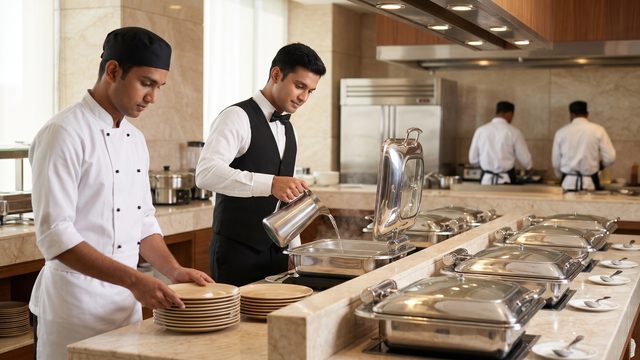 62. Breakfast buffet set-up and the live egg station
5:57