Module 8: Kitchen foundations · Lesson 57 of 79 · 5:39 · English
Knife skills and the basic cuts
Join the waiting list
Log in
Free. We create your login and email it to you. All 79 lessons included.
Transcript
0:00
Welcome to the chef course. In this video you will learn to use a knife correctly and safely: how to hold it, how to cut vegetables, and the basic cuts every hotel kitchen uses, from julienne to dice.
0:15
These are the basic kitchen knives. The chef's knife, 20 to 25 centimetres long, does most of the work. The small paring knife is for peeling, the serrated bread knife for bread, and the boning knife or cleaver for bones.
0:31
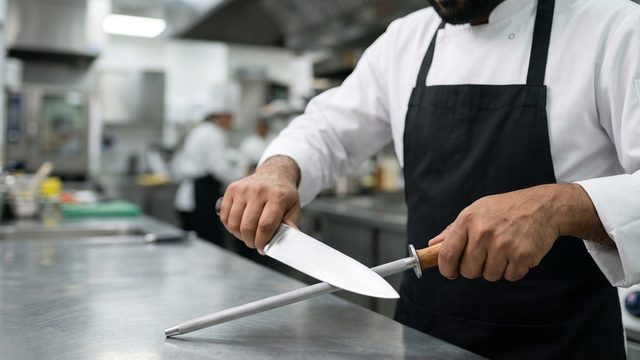
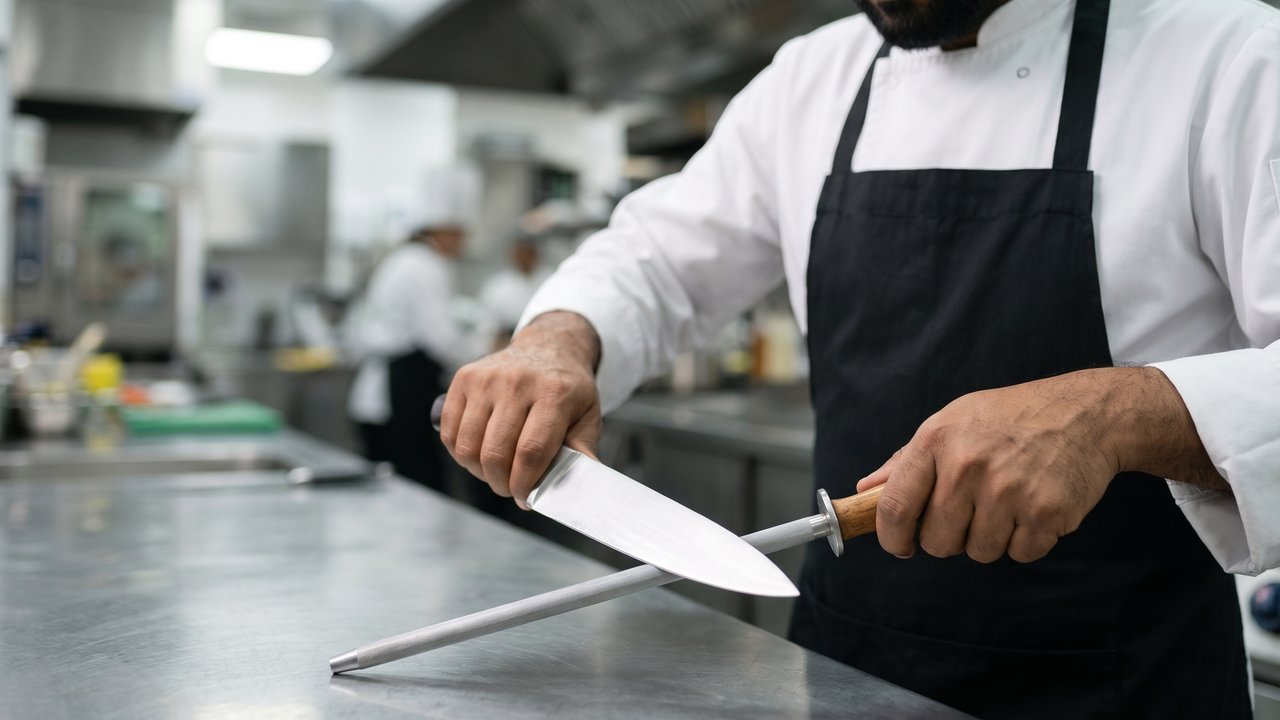
The first rule: a sharp knife is safer than a dull one. A dull knife needs force, it slips, and it cuts your hand. Before every shift, straighten the edge on a honing steel at a slight angle, like this.
0:46
Put a damp folded cloth or a rubber mat under the board so it cannot move. Remember the colour rule for boards: red for raw meat and chicken, green for vegetables. Keep only what you are cutting on the board.
1:01
The correct way to hold a knife is the pinch grip. Pinch the blade just in front of the handle between your thumb and index finger, and wrap the other three fingers around the handle. This gives you full control.
1:15
Your other hand uses the claw grip. Curl your fingertips inwards, like a claw, so the flat of the blade rests against your knuckles and your fingertips stay well away from the edge of the blade at all times.
1:28
Do not chop up and down like an axe. Keep the tip of the knife on the board and let the blade rock forward and down through the food in one smooth motion. Accuracy comes first; speed comes later.
1:42
Cutting an onion: halve it from root to tip and peel it, but leave the root on so the layers hold together. Make thin lengthwise cuts, one or two horizontal cuts, and then slice across for fine, even dice.
1:56
Learn the standard cut sizes of a hotel kitchen. Julienne is 3 millimetres thick and 5 centimetres long. Batonnet is 6 millimetres thick. Brunoise is 3 millimetre cubes, and dice comes in 6, 12 or 20 millimetres.
2:13
For julienne, cut the carrot into 5 centimetre pieces and square off the sides to make a block. Cut thin planks, stack them, and slice them into fine, even matchsticks. Julienne is used in salads and stir-fries.
2:29
For brunoise, gather the julienne sticks together and cut across them every 3 millimetres. You get tiny, even cubes, which are used in sauces, omelettes and garnishes. Keep all the pieces the same size, like this neat mound.
2:45
Batonnet is the thicker stick, 6 millimetres. Potato batonnets become fries. Cut them across at 6 millimetres and you have small dice, which is used for breakfast potatoes and in curries. Keep every piece the same.
3:00
For mint, spinach or salad leaves, use chiffonade: stack the leaves, roll them tightly like a cigar, and slice them into fine ribbons. For finely chopped coriander, rock the knife back and forth over the pile.
3:15
Chop or crush garlic, ginger and green chilli finely. After handling chillies, wash your hands and do not touch your eyes. When you cut tomato for an omelette, scoop out the seeds so it does not release water.
3:30
Cut raw chicken only on the red board. Slice boneless chicken across the grain into strips so it cooks tender. As soon as you finish, wash and sanitise the board and the knife before anything else touches them.
3:44
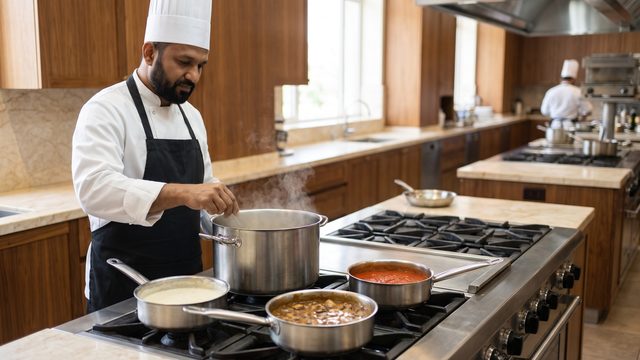
Why must every cut be even? Even pieces cook at the same time. If some pieces are big and some small, some stay raw while others burn, and the plate looks untidy, as you can see in the second pan.
3:58
To carry a knife, hold it at your side, point down and blade facing back, and call out: knife. To hand a knife to someone, lay it on the counter and let them pick it up; never pass it hand to hand.
4:12
If a knife falls, never try to catch it. Step back and let it fall, as the commis does here. Never leave a knife on the edge of the counter either; rest it on the board with the blade facing inwards.
4:26
Never put a knife in a sink full of water; someone will reach in and get cut. Wash the knife on its own straight away, dry it, and put it on the rack or the magnetic strip, never loose in a drawer.
4:40
The honing steel straightens the edge every day, but when the blade becomes dull it must be sharpened on a whetstone, for example once a week. This is a job for a trained cook or the chef, not a beginner.
4:54
If you cut your hand, stop work, wash the wound and press on it, put on a blue waterproof plaster and a glove, and tell the chef. Throw away any food the blood touched. A deep cut needs a doctor at once.
5:08
Practise every day. Each morning, as you cut onions, carrots and tomatoes, pay attention to the size. Speed will come with time. Let the chef check your cuts and tell you where you can still improve.
5:22
Remember: a sharp knife, a board that cannot move, the pinch grip and the claw grip, even cuts, carry the knife point down, never catch a falling knife, and never leave a knife in the sink. Thank you.